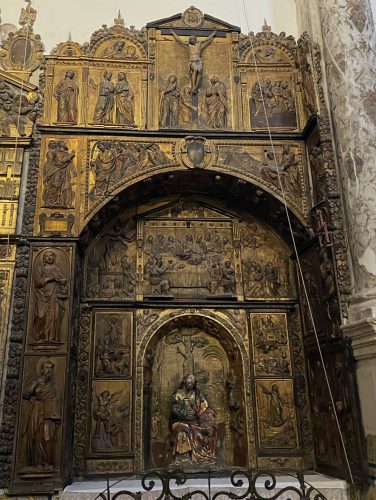
Continuing along the Gospel wall, just before reaching the Capilla Mayor, stands this altarpiece dedicated to Saint John the Evangelist. Renaissance in style and dated to around 1580, it draws formal inspiration from triumphal arches. The work is also attributed to Miguel Adán, although it was initially ascribed to Pedro Delgado and even to Jerónimo Hernández.
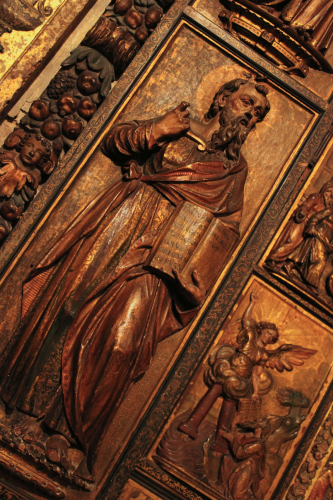
The altarpiece is devoted to Saint John the Evangelist and presents an iconographic programme centred on the Apocalypse and the life of the Apostle. It is entirely gilded, polychromed, and enriched with estofado decoration, incorporating numerous reliefs.
Its architectural composition is inspired by Roman triumphal arches and by the façade of the Hospital de la Sangre in Seville.
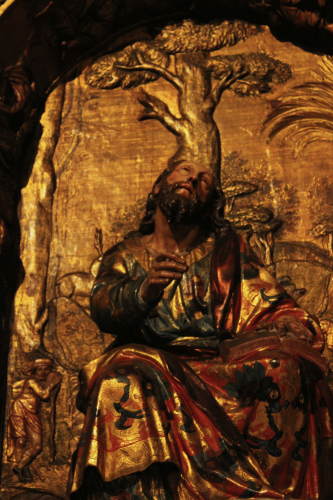
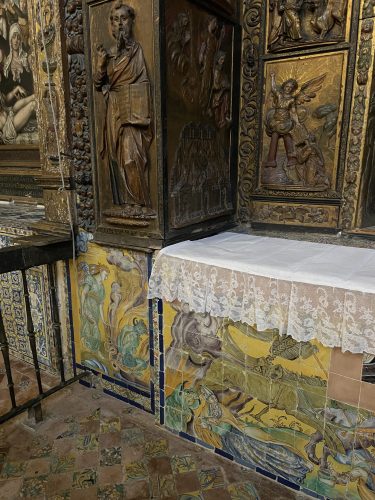
Structurally, the retablo is arranged in five vertical bays and two registers. The lower register is organised around a semicircular arch, while the upper register is crowned by a scene of the Dead Christ on the Cross accompanied by the Virgin, Saint John, and Mary Magdalene. This central scene is flanked by reliefs symbolising the Birth of the Church. Within the arch of the lower register lies a niche housing a fully sculpted figure of the Apostle, depicted at the moment of writing the Book of Revelation on the island of Patmos. Above this appears a relief of the Last Supper, framed by two pilasters and a triangular pediment. On the intrados of the arch are depicted the Virgin, the Christ Child, and God the Father.
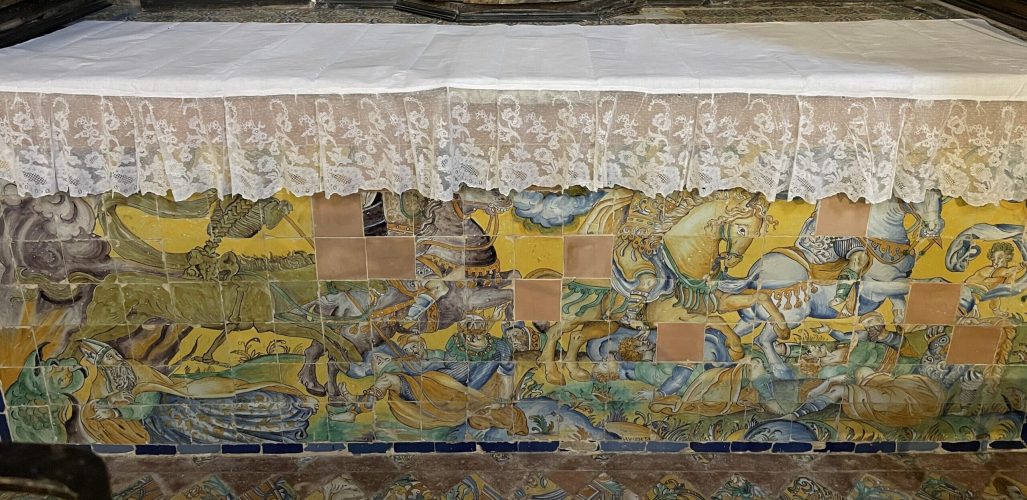
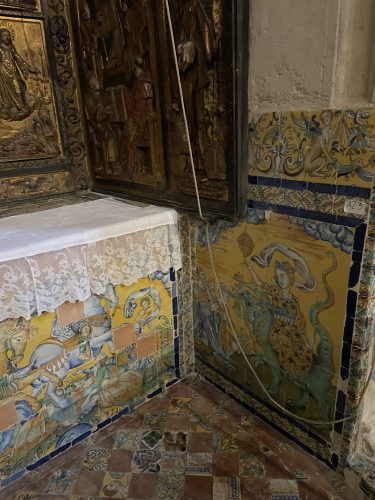
The front of the altar associated with the Altarpiece of Saint John the Evangelist is decorated in ceramic using the flat polychrome azulejo technique introduced by Niculoso Pisano (Niculoso Francesco Pisano Lupión). Its manufacture has been attributed to Cristóbal de Augusta and dates to the sixteenth century. At the centre is a representation of the Four Horsemen of the Apocalypse, now in a poor state of conservation, with significant deterioration and loss. On either side appear scenes depicting the seven-headed dragon crowned with seven diadems and other apocalyptic imagery. The dominant chromatic tones are yellow and cobalt blue.
General view of the altarpiece of Saint John the Evangelist.
Main sculpture depicting Saint John the Evangelist writing the Book of Revelation on the island of Patmos.
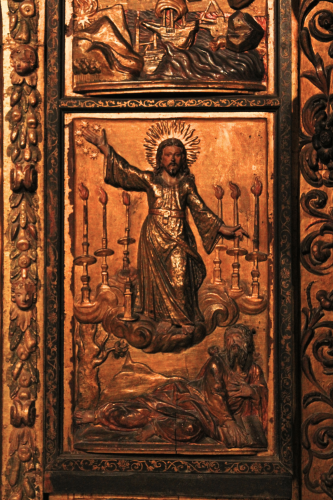
Side relief illustrating the apocalyptic scene of Saint Paul exorcising the chalice.