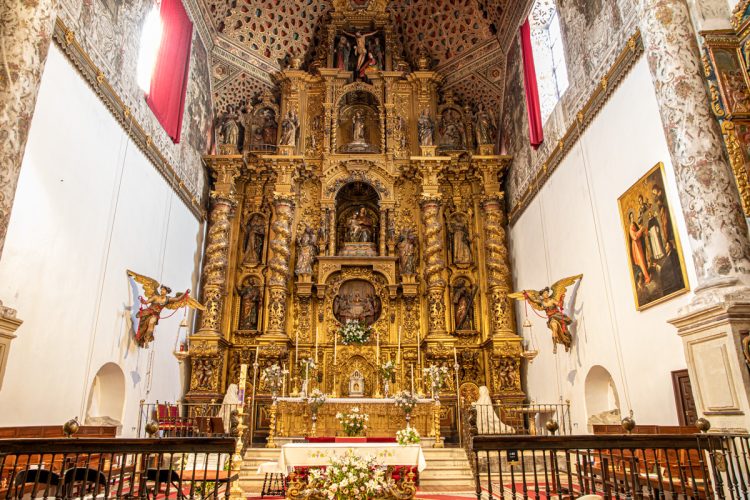
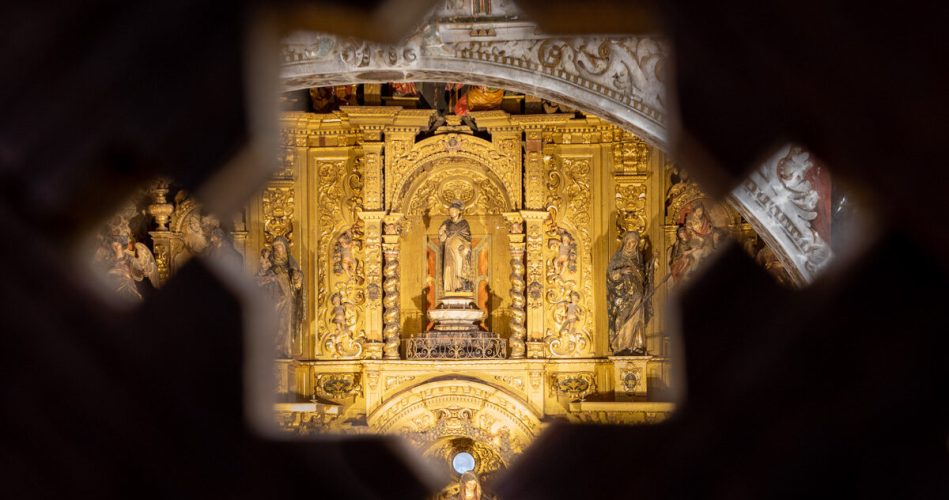
This monumental Baroque High Altarpiece is located in the Capilla Mayor, or presbytery, and served as a model for altarpieces produced in Seville during the first half of the eighteenth century, particularly in its use of Solomonic columns with varied design solutions.
It occupies the end wall of the Capilla Mayor, presiding over the nave of the church, and displays a marked vertical emphasis owing to the considerable height of the wall it covers. Its surface is richly adorned with vegetal ornamentation and cherubs.
The authorship of this imposing work is attributed to Francisco de Barahona, who executed it between 1702 and 1704, following the testamentary instructions of Captain Andrés Bandorne, benefactor of the community. The painter and sculptor Lucas de Valdés Leal also took part in the project, as did the gilder José López Chico. This altarpiece replaced an earlier, now lost, retablo by Juan de Oviedo and Jerónimo Hernández.
Structurally, it is arranged in three registers surmounted by an attic, with two lateral bays narrower than the central one. The predella, or lower register, serves as the base for the Solomonic columns of the second tier, which rest upon four voluted corbels adorned with pairs of small angels.
A doorway crowned by an arch opens on each side, corresponding to the space between the two upper columns.
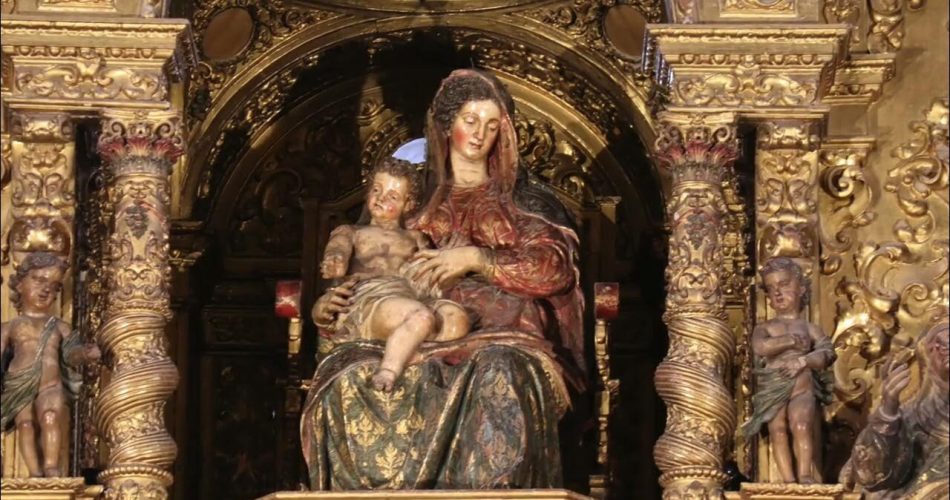
The second register continues the tripartite division of the lower level. It is the most prominent and substantial section, housing the principal sculptures of the ensemble, notably the enthroned image of Nuestra Señora del Rosario, also known as Madre de Dios de la Piedad—the title by which the convent itself is known—who presides over the retablo. The image is set within a camarín framed by an arch and flanked by paired columns and pilasters, and she is depicted presenting the Christ Child seated upon her right knee.
Main altarpiece, created between 1702 and 1704 by Francisco de Barahona.
Mother of God of Piety, carved between 1571–1572 by Gerónimo Hernández.
The sculpture, dated 1571–1572, is the work of Jerónimo Hernández. Carved in polychromed wood, it displays pronounced dynamism and the gentle, tender facial expressions characteristic of the artist. Originally, it formed part of the earlier altarpiece, alongside kneeling figures of Saint Dominic of Guzmán and Saint Catherine of Siena, now located in the lower choir of the convent.
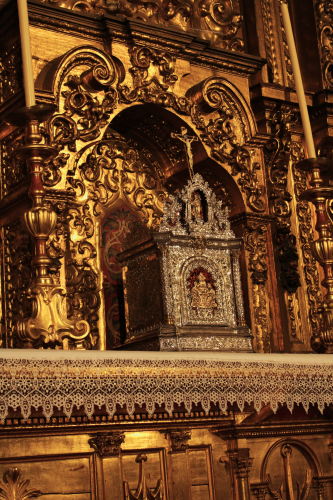
The tabernacle dates from the twentieth century and is a work of silversmithing; its door is decorated with scenes of the Supper at Emmaus.
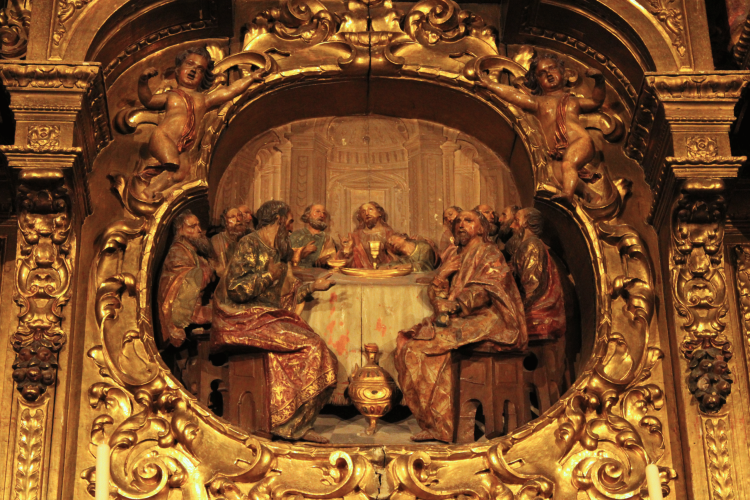
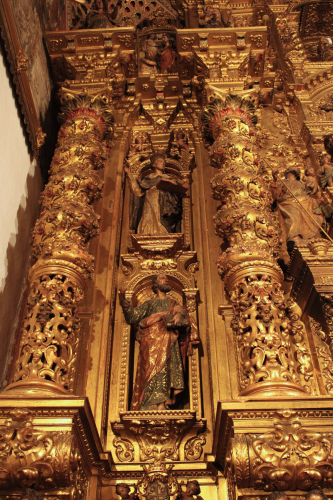
Beneath the camarín is a Baroque medallion containing a high relief of the Last Supper, notable for its strong sense of perspective and framed by emphatically curved forms. On either side, between this relief and the Virgin’s niche, stand figures of Saint Joseph with the Child and Saint Anne with the Virgin. In the lateral bays of the second register are four sculptures representing Saint Peter, Saint Andrew, Saint Thomas Aquinas, and Saint Vincent Ferrer. This sculptural ensemble, executed by Francisco de Barahona, exemplifies a naturalistic Baroque realism.
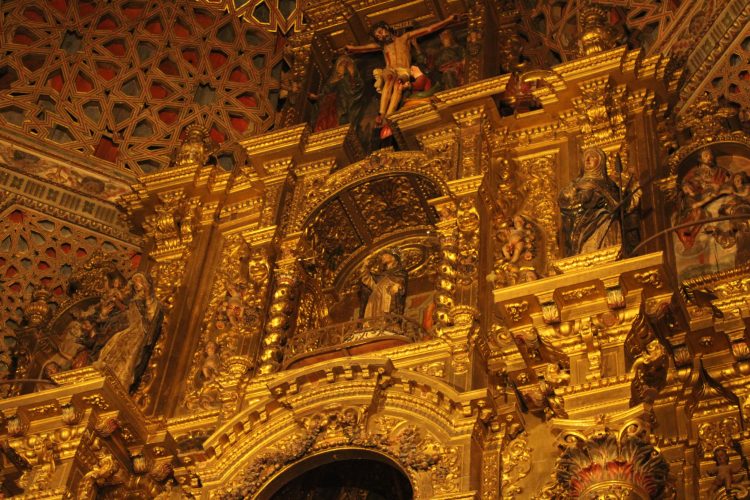
The third register is dominated by a sculpture of Saint Dominic placed within a niche framed by two small Solomonic columns. The figure wears the habit of the Dominican Order, its iconographic clarity outweighing the refinement of its execution. Flanking it are sculptures of Saint Rose of Lima and Saint Margaret of Savoy, set beneath semicircular arches, followed by high reliefs depicting the Baptism of Christ and the Miracle of the Porziuncola.
20th-century tabernacle
High relief of the Last Supper
Sculptures of Saint Thomas Aquinas and Saint Paul
Carving of Saint Dominic in the center, with Saint Rose of Lima and Saint Margaret of Savoy on the sides.
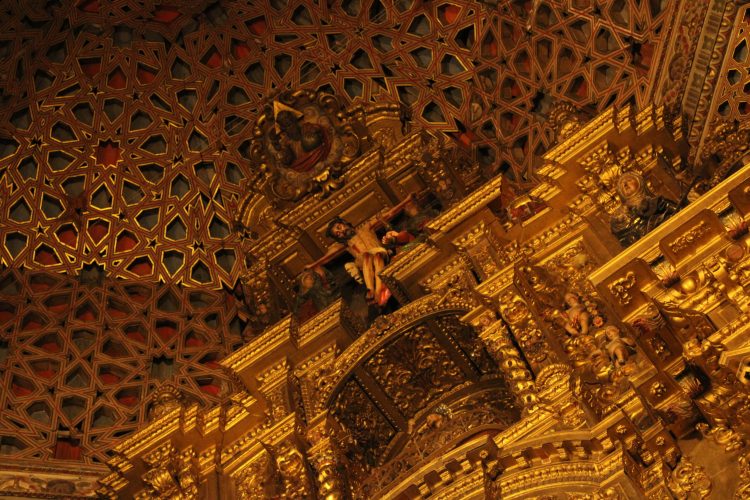
In the attic of the altarpiece appears a sculptural group of the Calvary—Christ on the Cross accompanied by the Virgin, Saint John, and Mary Magdalene—carved by Jerónimo Hernández for the original retablo and preserved during the later renovation. Dating from 1571–1573, the polychromed wooden Christ is life-sized, characterised by serene expression and subtle movement.
Above this group there once stood a figure of the Risen Christ, later replaced by a relief of God the Father, which now serves as the culminating element of the iconographic programme. The Risen Christ is currently housed in the upper ante-choir.
Attic of the altarpiece, with carvings representing the Calvary and the relief of the Eternal Father.
Attic of the altarpiece with the carvings of Saint Dominic, Saint Rose of Lima, and Saint Margaret of Savoy. Above them are the carvings representing the Calvary.
Recumbent Sculptures
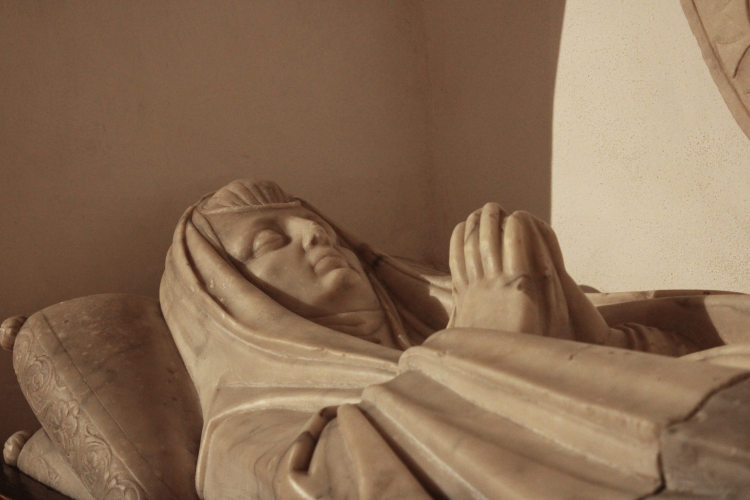
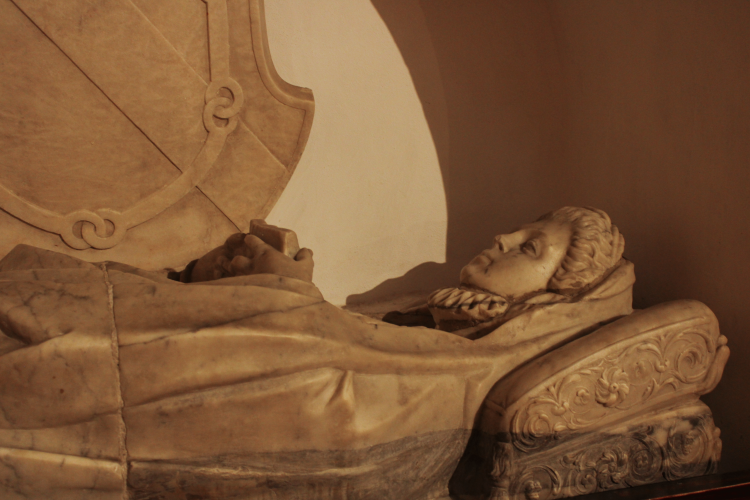
On either side of the Capilla Mayor are the sixteenth-century recumbent effigies of Doña Juana de Zúñiga—granted patronage of the Main Chapel—and her daughter, Doña Catalina Cortés, respectively the wife and daughter of Hernán Cortés.
Each sculpture is set within a simple white wall niche: Doña Juana de Zúñiga on the left side of the presbytery, and Catalina Cortés on the right, both oriented towards the High Altar. The works are attributed to Juan de Oviedo and Miguel Adán, with greater participation by the latter. They exhibit a marked classicism and refined softness in their carving, recalling the stylistic influence of Jerónimo Hernández, whose works are also present in this convent.
Carved in Genoese marble, each figure rests upon a richly decorated cushion. Doña Juana de Zúñiga is depicted wearing a religious habit and mantle, the folds of which are finely rendered in marble; her hair falls smoothly. By contrast, her daughter’s hair is softly waved, lending a more youthful and expressive character—she was twenty-nine at the time of her death. Catalina is attired according to the fashion of her period, wearing a voluminous mantle and an ornate lace ruff, and holding a devotional book. Within each niche appears the noble coat of arms of the Zúñiga family, originally polychromed.
Additionally, on either side of the altar stand two recently installed kneeling sculptures of Doña Juana de Zúñiga and her daughter Catalina. These are copies of the originals preserved in the Mudéjar cloister (Claustrillo) of the Cartuja of Seville.
Pantheon of Doña Juana de Zúñiga, wife of Hernán Cortés.
Pantheon of Doña Catalina Cortés, daughter of Hernán Cortés.