
Interior of the church
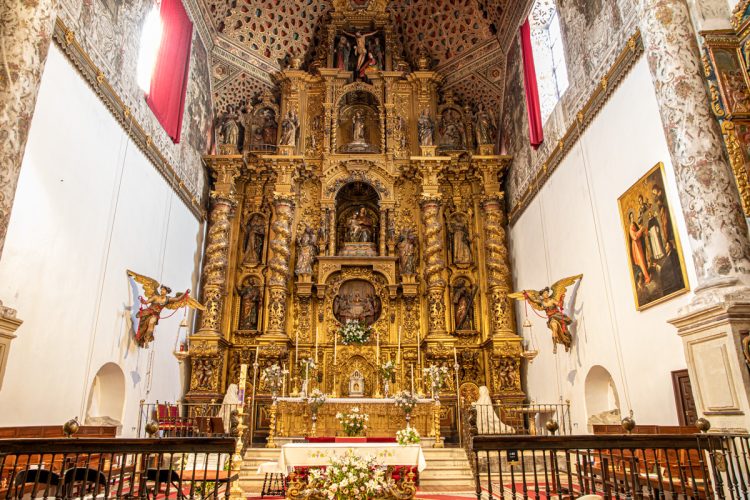
The ground plan of the church consists of a single nave of the so-called hall or box type. It is laid out as a rectangle measuring 45.38 metres in length and 10.24 metres in width. Within this space are chapels, altarpieces, religious sculptures and recumbent effigies, funerary slabs, painted works, as well as examples of wrought ironwork and glazed tile decoration.
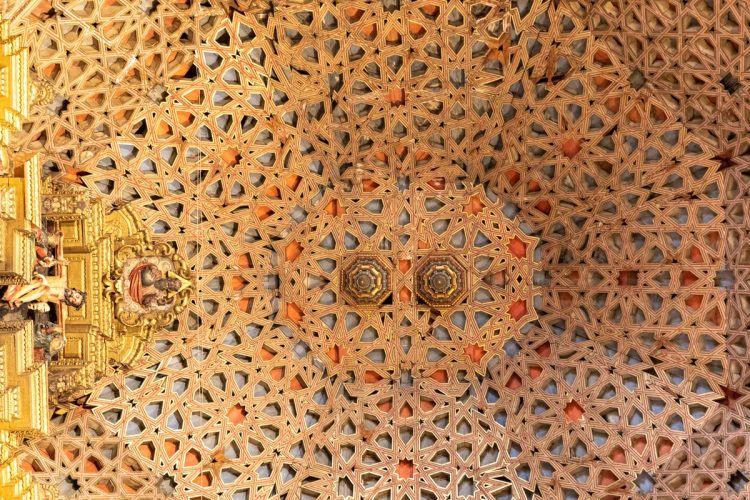
The architectural scheme corresponds to one of the models commonly employed in the sixteenth century: a spacious and lofty nave with a presbytery and two choirs—one upper and one lower—entirely covered by large timber roof structures richly adorned with lacería (interlacing geometric patterns). The carpentry ranks among the finest examples of Sevillian Mudéjar craftsmanship. In particular, the alfarjes (coffered wooden ceilings), executed in 1564 by Alonso del Castillo, Francisco Ramírez and Alonso Ruíz, stand out for their quality.
The construction of the church took place in several phases during the second half of the sixteenth century, although the original designer of the project remains unknown. According to Celestino López Martínez, the works were directed by Juan de Simancas—Master of Works to the Royal Alcázars—and Pedro Díaz de Palacios, the latter closely associated with Hernán Ruíz II.
The church’s frescoes are located in the Capilla Mayor (Main Chapel) or presbytery, on the chancel arch, and along the walls, which display an abundant decorative programme.
Part of the once notable picture collection was looted following the Revolution of 1868, and only a few works have been preserved. Among them is the canvas of Saint Dominic in Soriano, positioned high on the left wall, together with the seventeenth-century Preaching of Saint Vincent Ferrer. The former, painted by Juan del Castillo between 1635 and 1638, reflects a synthesis of Mannerist and naturalistic tendencies and alludes to a miraculous legend associated with Saint Dominic of Guzmán.
Other significant paintings include the Martyrdom of Saint Lawrence, attributable to the Flemish painter Pieter Van Lint (mid-seventeenth century), and Saint John the Baptist by Pedro Atanasio Bocanegra, dated 1673.
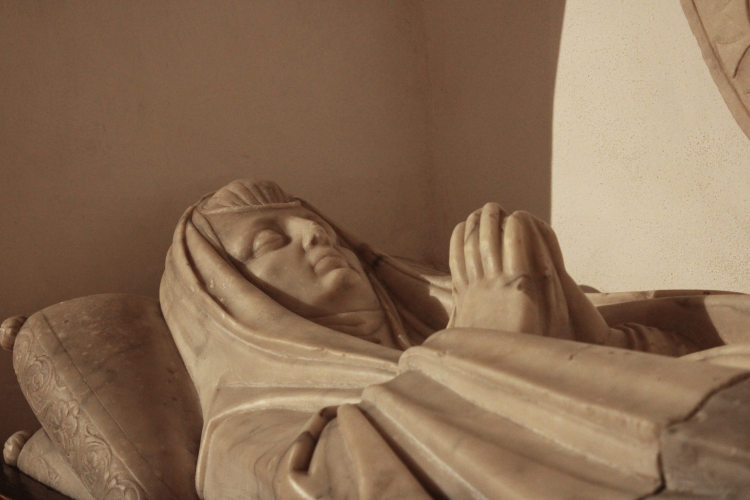
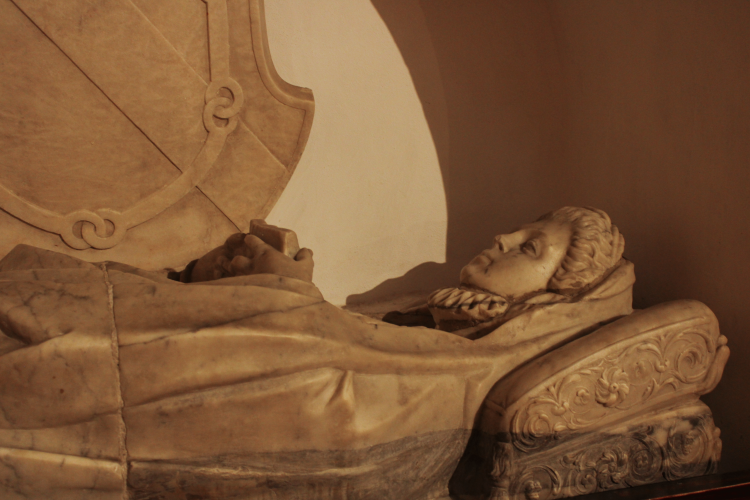
Among the sculptural works, particular attention should be paid to the recumbent effigies located on either side of the Capilla Mayor. They represent Doña Juana de Zúñiga—granted patronage of the Main Chapel—and her daughter, Doña Catalina Cortés, a professed nun in the convent, respectively the wife and daughter of Hernán Cortés.
Also noteworthy is the funerary slab of Diego Venegas, set in the centre of the nave pavement. Licenciado Venegas, Oidor(judge) of the Casa de la Contratación, expressed his wish to be buried in the church of the Monastery of Madre de Dios.
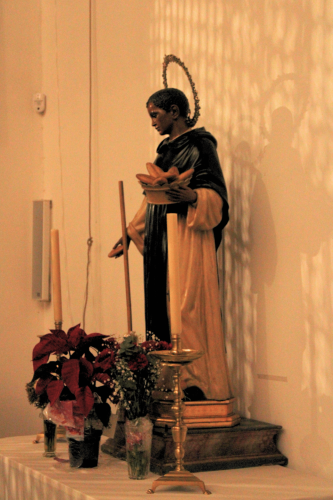
Upon entering the church, to the right of the vestibule screen, a modest altar dedicated to Saint Martin de Porres has recently been installed.
To learn more:
Palomero Páramo, J. M. (1983). El retablo sevillano del Renacimiento. Análisis y evolución. (1560-
1629). Excma. Diputación Provincial de Sevilla.
Calderón Benjumea, C. y Calderón Benjumea, J. A. (2004). El Real Monasterio de Madre de Dios
de Sevilla. Ediciones Guadalquivir.
AAVV. (2024). Lugares de paz y oración. Hortus conclusus. Real Maestranza de Caballería.