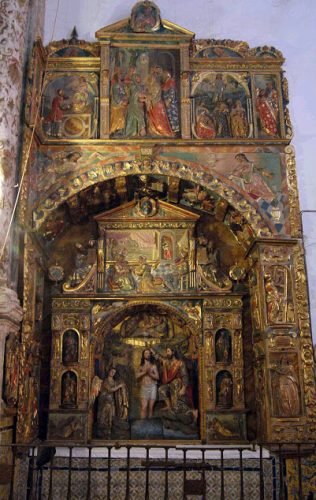
The altarpiece of Saint John the Baptist is located adjacent to the presbytery, directly opposite the Altarpiece of Saint John the Evangelist. It dates from 1575–1585 and is Renaissance in style. The chapel was originally endowed by Juan Martínez and María Fernández de Calderón. The work is attributed to Miguel Adán, based on stylistic similarities with other altarpieces of the same period.
Regarding its material composition, the architectural framework is crafted in borne wood, while the reliefs are made of pine from Segura, gilded, polychromed, and finished with estofado by Vasco de Pereira.
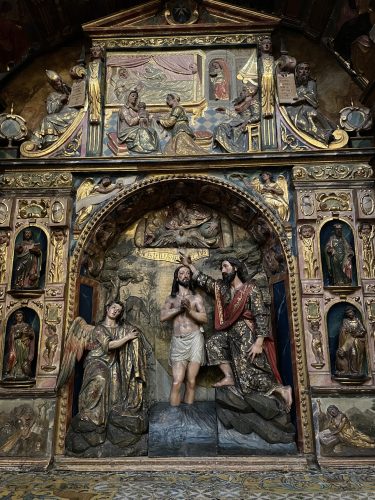
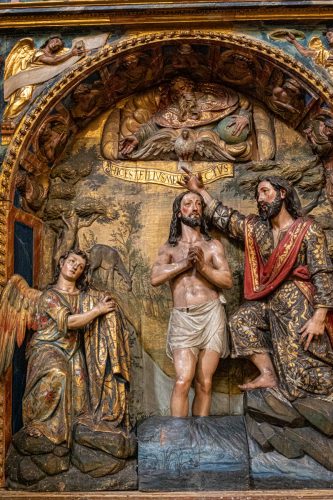
Structurally, the altarpiece is divided into two main sections: the lower register, which is the most prominent, and the attic crowning the ensemble. The lower section features a niche capped by a semicircular arch, housing a sculptural group depicting the Baptism of Christ in the Jordan. Christ is positioned at the centre, Saint John to the left performing the baptism, an archangel to the right, the Holy Spirit as a dove above them, and God the Father completing the scene above. In the spandrels of the arch are the Archangel Gabriel and the Virgin Mary, arranged to create an Annunciation motif alongside the dove and a branch of lilies, also depicted. Other iconographic elements of the altarpiece include scenes of Saint Mary of Egypt and Saint Mary Magdalene at the Baptism, the four Evangelists, the testimony of the Baptist, the Beheading of John, and King David. Above these, small figures of the Infant John (San Juanito), Zechariah, and Isaiah are depicted.
The main scene in the attic, crowned by a triangular pediment containing a cartouche with God the Father, depicts the Visitation of the Virgin to her cousin Saint Elizabeth.
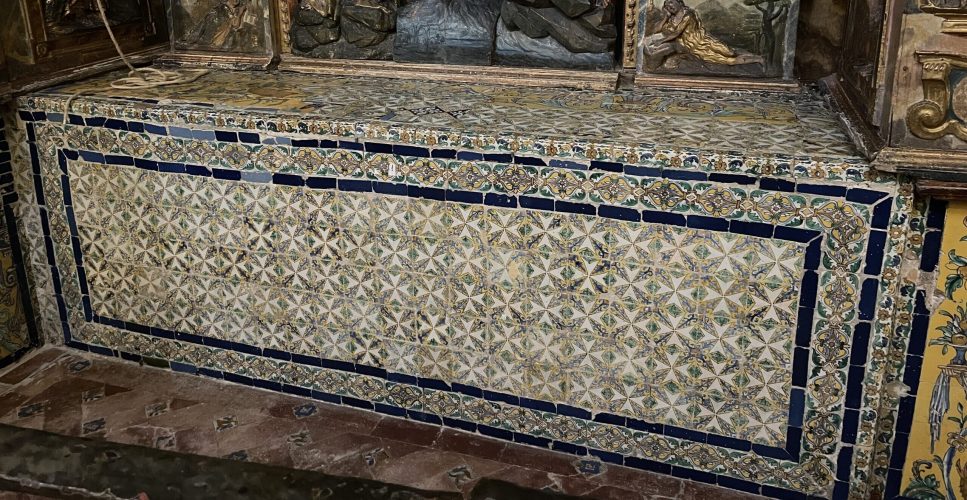
The altar frontal of the Saint John the Baptist altarpiece is executed in polychrome azulejos, featuring a base decorated with floral motifs and a white cross symbolising the Precursor. The entire front is framed by a floral border running around the rectangular panel. This work is attributed to the ceramist Roque Hernández, showing strong Flemish influence, and is dated to the sixteenth century.