Altarpiece of the Holy Burial of Christ
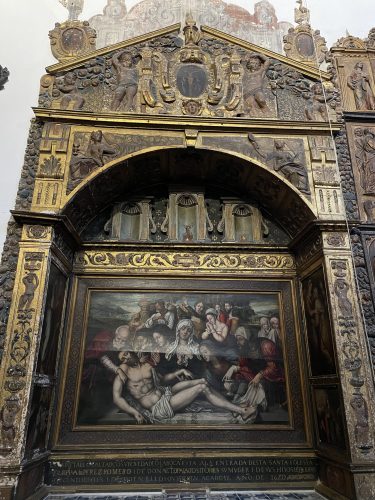
Executed between 1580 and 1585, the altarpiece undoubtedly reflects the participation of Miguel Adán in its conception.
Upon passing through the vestibule screen, the altarpiece of the Holy Burial of Christ is located on the left-hand side, along the Gospel wall. Renaissance in style, it is structured around a blind semicircular arch conceived as a niche, within which a panel painting depicting the Holy Burial is set. The greater part of the architectural framework is gilded, while other sections are polychromed and enriched with estofado decoration.
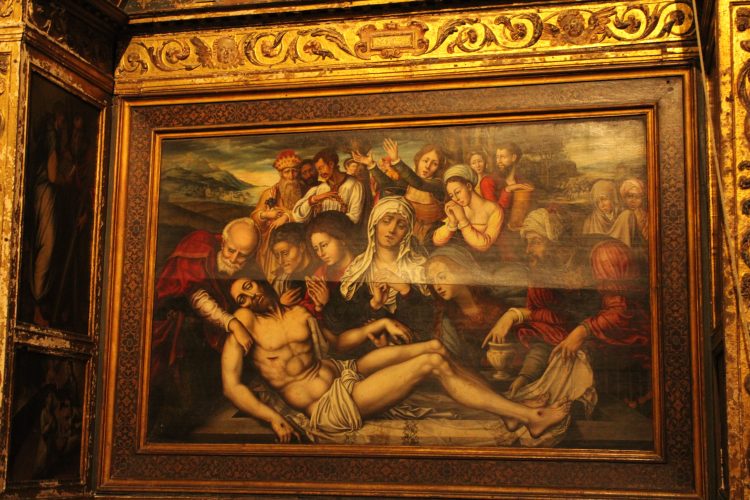
The name of the altarpiece derives from the central oil-on-panel painting representing the Burial of Christ. The scene captures the moment in which Christ is being embalmed by Joseph of Arimathea and Nicodemus. The figure of our Lady serves as both the compositional and symbolic axis of the work; she is rendered on a larger scale than the remaining figures, a device that enhances the perspectival effect. All the protagonists convey the grief and solemnity of the mournful episode depicted. Various scholars attribute the painting to the Flemish school, circa 1525, although no definitive consensus has been reached.
The lateral sections of the altarpiece are adorned with panel paintings. On the left are Saints Andrew and James; on the right, the Visitation of the Blessed Virgin Mary, likewise executed on panel. These works have been attributed to Villegas Marmolejo around 1575, owing to their stylistic affinity with another painting of Saint James by the same artist in the Altarpiece of the Visitation in Seville Cathedral.
However, the paintings incorporated into the altarpiece do not all share the same chronology. It is therefore assumed that the aforementioned lateral panels were originally produced for a different setting and subsequently reused here. This does not apply to the smaller paintings situated on the lower tier of the lateral sections, which correspond chronologically with the execution of the altarpiece itself. These depict, on the left, the Imposition of the Chasuble on Saint Ildefonso, and on the right, the Martyrdom of Saint Catherine.
An inscription located in the lower register dates the painting to 1620. Nevertheless, several scholars question the reliability of this date, as the stylistic and technical characteristics, as well as the iconographic programme, correspond more convincingly to the years between 1580 and 1585.
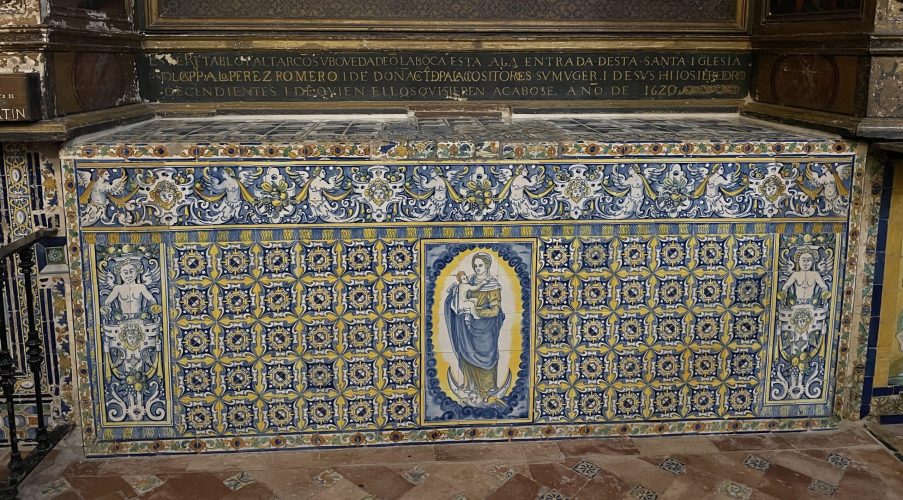
The authorship of the ensemble is generally inclined towards Miguel Adán. The altar frontal associated with the Holy Burial altarpiece is dominated by blue, yellow and white tones and decorated with Plateresque motifs. A geometric pattern forms the background, while at the centre appears a Virgin standing upon a crescent moon and holding the Christ Child, recalling the iconography of the Immaculate Conception.
The upper section is embellished with a decorative frieze of winged angels and garlands, while the sides feature symmetrically arranged winged figures. This decorative programme is framed within the artistic context of the seventeenth century.